
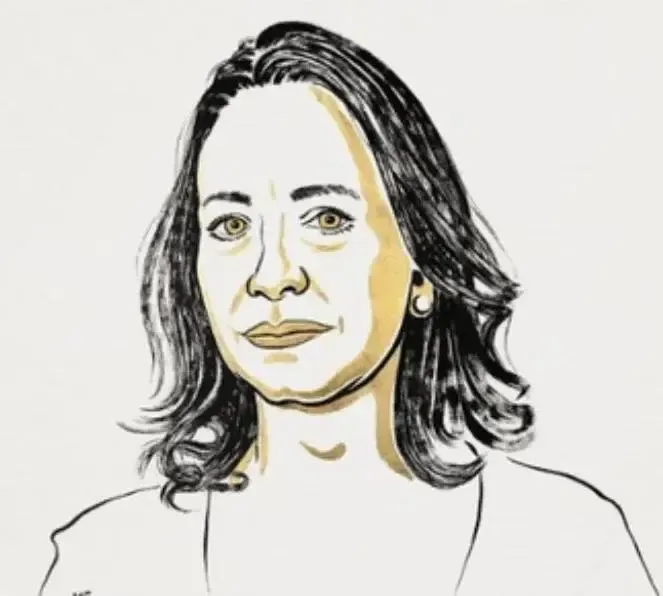
I was happy when I first read that María Corina Machado had been awarded the Nobel Peace Prize and posted accordingly. At least, I thought, the committee had not fallen prey to Donald Trump’s propaganda, nor to the endorsements from Pakistan’s Munir and Shehbaz, or Israel’s Netanyahu, nor to the millions spent every year by public relations firms to manufacture heroism. For a fleeting moment, I was relieved — perhaps the Nobel had resisted political contamination. I got swayed away from facts and felt, almost sentimentally, the light of Latin American democracy flicker once more. It seemed only right that the world should honour her.
But the more I read, the less I felt that familiar reverence that usually surrounds the Nobel name. What began as admiration soon turned into unease and, finally, disillusionment.
The Nobel Peace Prize, unlike the prizes for science or literature, has always had a more complicated parentage. It is not awarded by the Swedish Academy, but by a Norwegian committee, and over time it has strayed from Alfred Nobel’s original intent. Its record is dotted with triumphs; Martin Luther King Jr., Nelson Mandela, but also with glaring misjudgments.
Two recent names come to mind: Abiy Ahmed, who won the prize in 2019 for bringing peace to Ethiopia and soon after waged one of the bloodiest wars in the country’s history; and Aung San Suu Kyi, once a global icon of nonviolence, later complicit in the persecution of the Rohingya. The committee, it seems, has often been more eager to crown than to question.
And now, it is Machado.
Her opposition to Nicolás Maduro’s regime is understandable. No one can defend Venezuela’s corruption, repression, or economic collapse. But Machado’s politics tell a more troubling story. She has supported U.S. sanctions against her own country; sanctions that a 2019 study by the Center for Economic and Policy Research (CEPR) estimated caused more than 40,000 deaths in just one year, largely due to shortages of food, medicine, and critical supplies.
International law, under the Geneva and Hague Conventions, explicitly prohibits collective punishment of civilian populations. Sanctions that starve a nation are not acts of peace; they are acts of war conducted by economic means.
How, then, does a person who endorses such policies become a laureate of peace?
The contradictions do not end there. Machado has expressed open sympathy for Israel’s Likud Party, at a moment when that very government stands accused by Amnesty International and Human Rights Watch of apartheid and potential genocide in Gaza. To align oneself with such a cause is to turn away from humanity’s suffering, not towards it.
Even more troubling is her appearance this year at a European far-right conference that invoked the idea of a “New Reconquista” — a call steeped in the memory of the ethnic cleansing of Muslims and Jews from Spain. And in what feels like a deliberate provocation to reason itself, she dedicated her Nobel Peace Prize to Donald Trump. Trump; man who withdrew from the Paris Climate Accord, inflamed racial divisions, and threatened war more often than he spoke of peace.
So what does the Nobel Committee now mean by “peace”? Is it merely the victory of Western political narratives — the convenient definition of peace as the absence of resistance to power?
In George Orwell’s “1984,” the state’s slogans declared, “War is peace. Freedom is slavery.” Today, that phrase feels less like fiction and more like the world’s moral condition.
Once, the Nobel Peace Prize symbolized conscience. It stood for those who risked everything to preserve the sanctity of life. Now, I fear it rewards those who stand comfortably on the side of sanctioned suffering — as long as it is the right kind of suffering, inflicted by the right kind of powers.
When peace becomes politics, and morality becomes selective, prizes lose their meaning.
I wanted to celebrate María Corina Machado as a hero of democracy. Instead, I find myself mourning the decay of what the Nobel once represented ; a universal moral clarity that now seems tragically expendable.