
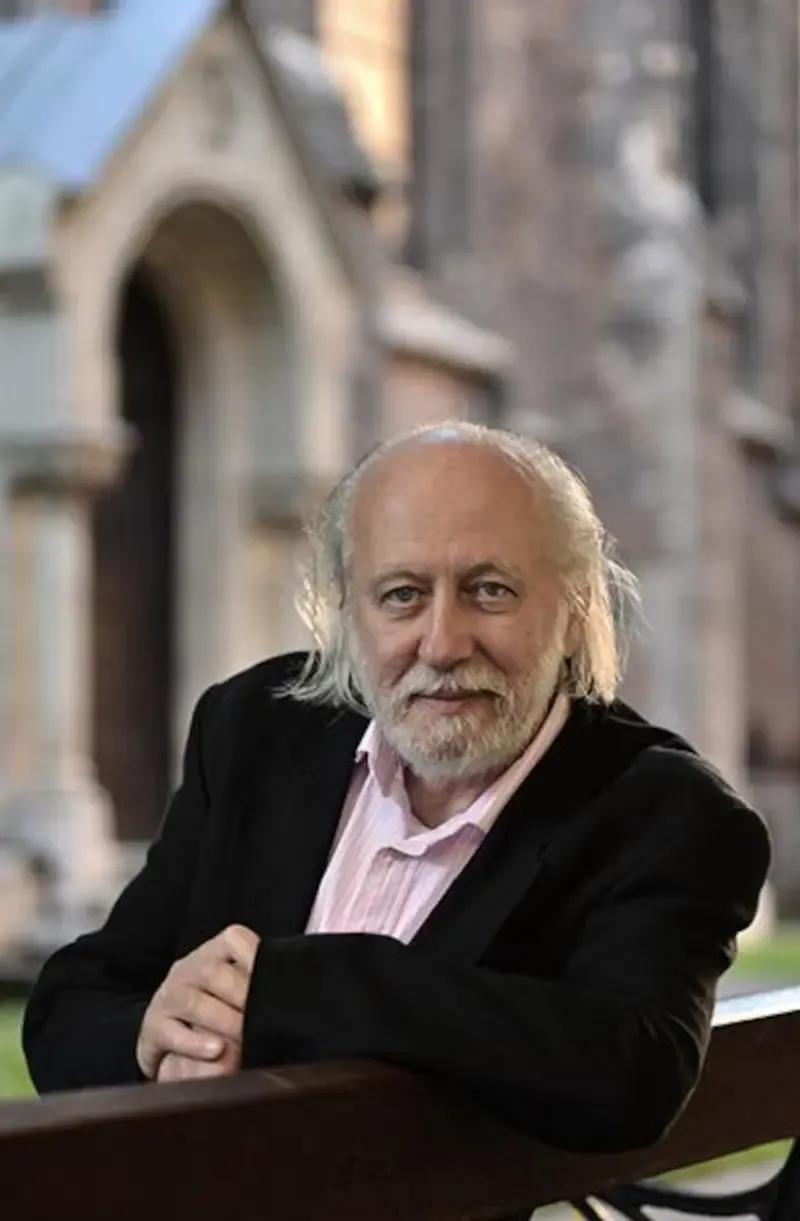
It is a remarkable and deeply deserved choice that the 2025 Nobel Prize in Literature has been awarded to László Krasznahorkai.
For many readers and critics, he has long stood as one of the most important living authors in Hungary, and this honour both vindicates and amplifies his singular contribution to world letters.
Krasznahorkai’s writing is not easy, nor is it comforting; yet it remains vital, visionary, and endlessly provocative, asking what art can do in the face of despair and what it means to persist when the foundations seem to be crumbling.
From the first, Krasznahorkai has embraced risk. His earliest novels, such as Sátántangó (1985), take place in decaying, desolate settings where normal social structures have disintegrated or become grotesque shadows of themselves. In that debut, he gives us villagers caught in a limbo of expectation and betrayal, of hope manipulated and trust shattered. There is no illusion of stability; there is instead a reality that is both claustrophobic and epic, bleak yet alive with the human impulse toward meaning even when it feels impossible.
His prose makes every word carry weight, not simply by what it says, but by how it says it: dense, flowing, unrelenting, often in sentences that seem to stretch until the reader feels both stifled and exalted. This collision of form and content, of content that refuses to spare the darkness, and form that compels the reader to stay in that darkness, is where his power lies.
Krasznahorkai’s thematic world is one of apocalypse; not in the sense of prophecy or spectacle, but as present condition. His are journeys through collapse, decay, ruin, disintegration of belief, with humanity often on the brink of losing its bearings. Yet in that apocalypse he does not surrender art or imagination.
The Nobel citation commends him “for his compelling and visionary oeuvre that, in the midst of apocalyptic terror, reaffirms the power of art.” This phrase captures what makes him extraordinary: he does not use art merely as a refuge, but as a site of resistance. Even when despair seems almost absolute, his writing insists on awareness, on confrontation, on the possibility that beauty and meaning are not delusions but perhaps the only real things left. 
His vision is anchored in specific cultural, geographical, historical contexts; Hungary’s own complex twentieth-century legacies, the decay of collective ideologies, the dislocations of post-communist Eastern Europe, but the effect is universal.
Whether one reads The Melancholy of Resistance, War and War, Destruction and Sorrow Beneath the Heavens, or his more recent works, one is drawn into questions about what remains when ideologies fail, when hope is betrayed, when societies fracture. He is not interested in simple moralism; he avoids allegory that flatters the reader. Instead, he interrogates the uncomfortable, the absurd, the thresholds where the human meets the inhuman, where despair and transcendence brush against each other.
Krasznahorkai also embodies the idea that translations matter, that literary merit often lies beyond the reach of global markets until the work is brought into contact with translators, critics, film-makers, and readers outside its nation of origin. His collaborations with director Béla Tarr, for example, have made his bleak, expansive landscapes of ruin visible in film. These adaptations both extend and transform his voice, allowing another medium to reflect his vision back to us. The movement of his work into numerous languages in recent decades has already been opening up his impact; the Nobel will no doubt accelerate that. 
What this Nobel Prize to Krasznahorkai affirms is that literature does not need to be consoling to be essential, that it can hold the discomfort, the apocalyptic, the despair, without becoming inert, without giving in to mere nihilism. It upholds the idea that art can be an act of courage: courage to show what many would prefer not to see, courage to refuse easy closure, to dwell in ambiguity, to allow the fractures rather than smoothing them over.
It reminds us that in unstable, dangerous, cruel times, literature has a role not as ornament but as witness, as alarm, as balm, as provocation. In recognising Krasznahorkai, the Nobel committee has made clear that these are values worth celebrating, and that the reach of literature is expanded when we embrace voices that challenge us profoundly.