
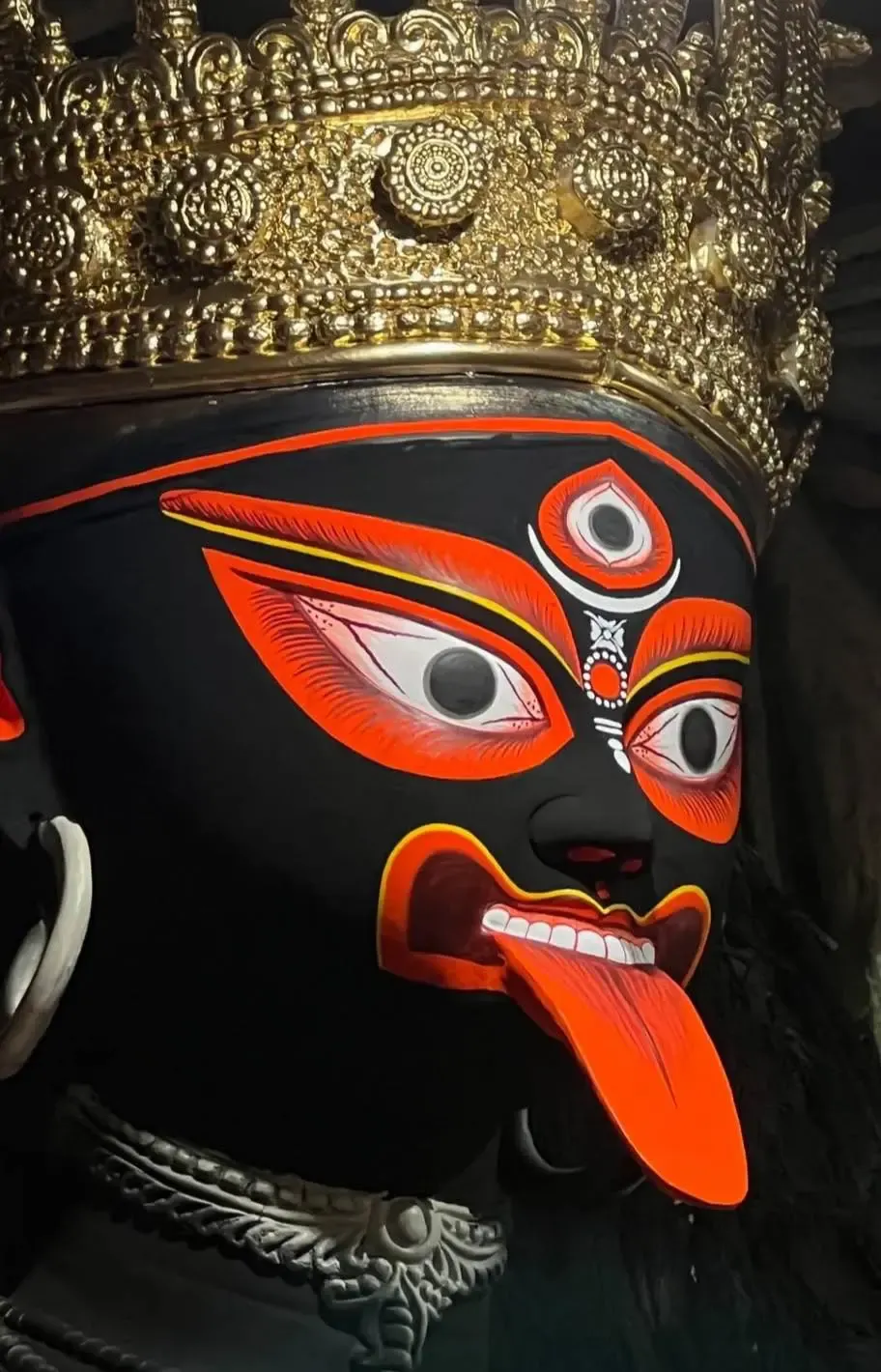
As I return home in the evening, in the dusk, I find many Kali idols being taken for worship. Not in silent prayer as when Durga idol is taken but, with much pomp and fervour. With thick smoke from aromatic resin (dhuno) filling the air. The Sashan Kali, still unfinished covered in red bordered white saree, more than four storeyed high reached the sky, with hundreds pulling the cart and thousands lined up on the road to greet her with conch and "Ulu dhwani" (ululation) renting the air.
In Bengal, when the midnight wind blows across the burning ghat, the lamps tremble by the river’s edge and traffic in the streets come to a halt it whisper: Ma eshechhe, the Mother has come.
Not Durga in her golden splendour, not Lakshmi with her lotus smile but Kali, the dark Mother, barefoot upon the ashes, her anklets ringing in the silence of death.
They say she dances there among the dying flames, among bones and shadows. Her laughter echoing through the tamarind trees. Yet that laughter is not madness; it is freedom.She dances upon the corpse of illusion, upon the arrogance of man, upon the pride that says I am.
The old folklore of Nadia and Birbhum tell that when Mahishasura’s blood soaked the earth, and the sky turned red with rage, Durga herself grew still. From her brow sprang a flame; dark,fierce, uncontainable.From that flame came Kali, her tongue red as sunset, her hair wild as monsoon clouds. The gods trembled, but Durga smiled, for she knew — “Yini andhakār, tini-i prakāś.” (“She who is darkness is also the light.”)
In the cremation ground she lives; Shmashan Kali. Her devotees bring her not garlands of jasmine, but the silence of the soul.The Tantriks come at new moon, carrying no gold, no incense — only their naked selves. They whisper mantras older than language, for they know she is not a goddess of the temple but of the threshold between life and death. In the Kalikula of Bengal, they say: “যার ভয়ে মৃত্যু ভয়ে, তাহার ভয়ে কালীর ভয় নাই।” (“She before whom Death itself trembles, fears none.”)
When the body burns, when the name dissolves, when the last breath leaves — she stands waiting, her arms open, whispering, Esho amar chele, ami aachhi: “Come, my child, I am here.”
Yet the same Mother who haunts the cremation ground walks through the lanes of Kolkata at dawn.She hides in the eyes of the beggar woman at Kalighat, in the cracked bell of Dakshineshwar, in the red hibiscus blooming by the drain. Ramakrishna called her Ma Kāli, not Mahākāli. For him she was not the destroyer of worlds, but the mother who feeds her child with the milk of compassion. “যদি মা কালী ডাক দাও, তবে সাড়া দেবে। অন্ধকারে, আলোর মতো।” (“If you call upon Mother Kali, she will answer — as light answers darkness.”)
To the devotee, her cruelty is tenderness in disguise. Her severed heads are the pride she cuts away. Her blood-smeared mouth is the hunger that devours ego. To fear her is to fear truth itself.
In Tantra, they say Kali is not only fear ; she is desire itself. Her dance is not only destruction, it is creation through passion. For passion, too, is divine, when stripped of selfishness. In every lover’s heartbeat, in every artist’s madness, in every rebel’s cry; the Mother dances. That is why the poets of Bengal, from Ramprasad to Bamacharan, sang not of fear but of longing: “আমার মন কেমন করে, কালী বলে ডাকে রে।” (“My restless mind keeps calling — Kali, Kali — in love, not in dread.”)
At the end of the world, when the sun is ash and the moon is smoke, she will dance again: naked, radiant, alone. Upon the still body of Shiva she will whirl, her anklets breaking the silence of Time. Every illusion will burn in her laughter, and every soul will find peace in her arms.
For that is her secret; the secret of the Dark Mother of Bengal:She destroys only to free. She devours only to love.And in her darkness, we find the most radiant light.